Wolf Range Repair
Wolf Range Burner Will Not Light in Boston: The Order to Check
If you smell gas that does not clear, leave and call the utility from outside. Otherwise: one position failing points at its own cap, ports and electrode, while all of them failing points at the shared module, supply or earth. Clicking proves the spark is firing and nothing more.
First, the part that is not negotiable. Smell gas that will not clear, and the only correct move is out: take everyone with you, leave the building, and call the gas utility once you are outside. Do not switch anything on or off on the way out, and do not call a repair company first. Everything below assumes a Wolf range that clicks, or lights badly, with no gas smell hanging about the room.
Start by finding out how much of the range is affected
One question halves the problem before anybody kneels on the floor: is it one position or all of them? A single burner that will not catch while its neighbours behave points at that burner’s own hardware — the cap, the ports beneath it, the electrode beside it. Every position failing at once points past all of that, at the module, the supply or the earth they share.
Most ranges run every electrode from one spark module, so turning a single knob makes the whole top click. That is normal and it confuses people constantly: clicking from four positions does not mean four faults. What matters is which position produces a flame, not which ones make a noise.
A third fault, separate from both of those, is a range that goes on clicking while every knob sits at off. Nothing has been asked of the range, but a switch behind one of the knobs is asking the module to fire anyway, and it will keep asking until the range is isolated. It is not dangerous the way a gas leak is dangerous, but it is not something to live alongside either.
Write down what you find before changing anything: which positions light, which click, how long each takes, and whether the flame that eventually arrives looks right. In South Boston kitchens, where a professional range has frequently been dropped into a three-decker layout built around a much smaller stove, a back burner sitting hard against a wall run often behaves differently from the rest — and that pattern is a finding in itself.
Seating, debris and the boil-over nobody mentioned
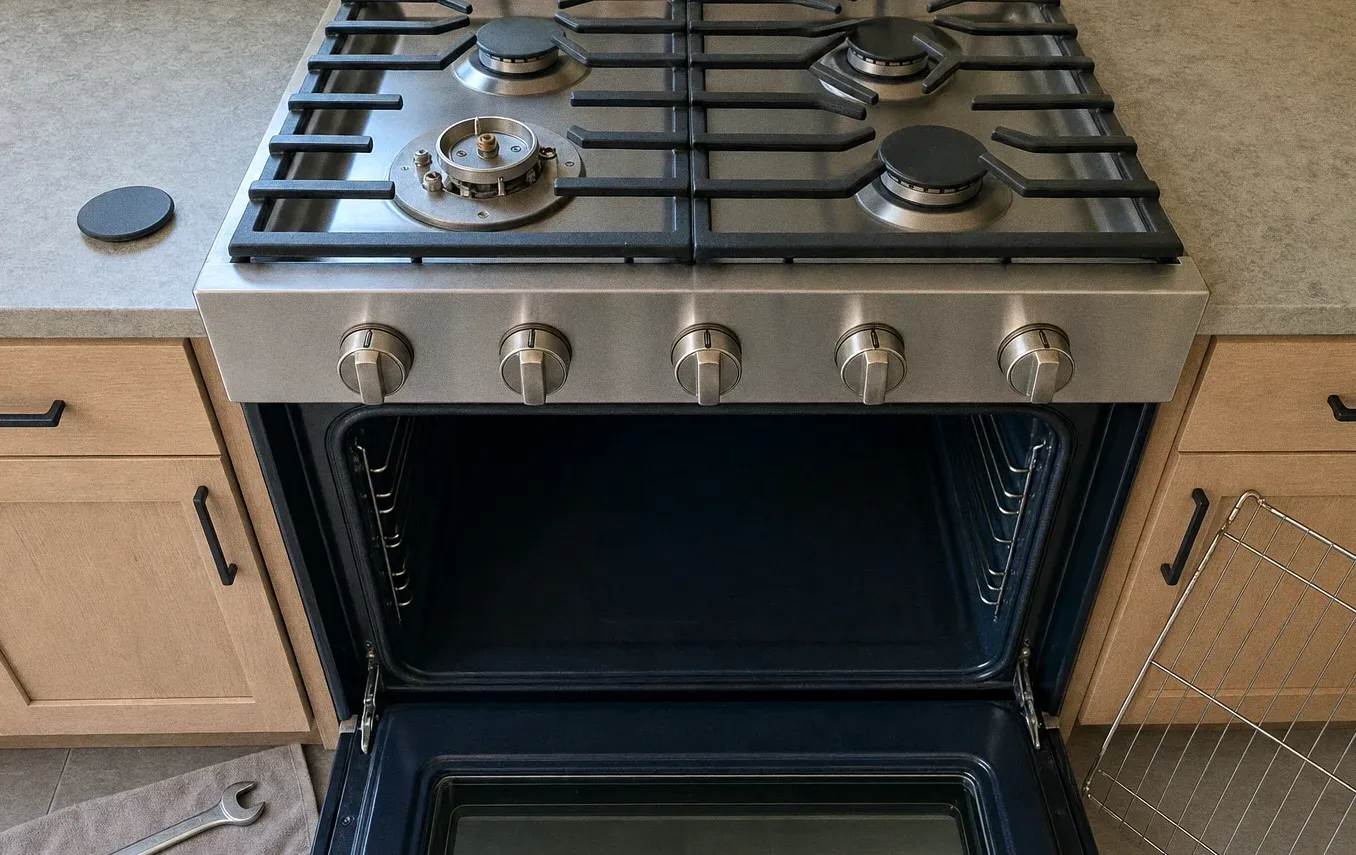
The commonest cause of a position that clicks and will not light is not electrical at all. It is a cap sitting a fraction out of place. Cap and head are machined to meet in one orientation, and a millimetre of lift or a slight rotation changes where gas emerges and where flame can travel — so the spark can be perfect and have nothing in front of it to ignite.
Take the cap off cold and look at the ports around the rim of the head. A boil-over nobody mentioned will have run into them and dried; so will the residue from a pan that spat fat for twenty minutes. Clear them with a straightened paperclip or a stiff brush, working from the outside inward, and never with anything that could widen or deform a port. Then look at the head itself for the locating features the cap sits on.
Refit dry, and confirm the seating rather than assuming it. The cap should sit flat, sit still and not rock when nudged; if it turns freely through a wide arc it is not on its locators. Do this carefully on the position that failed and then repeat it on one that works, so you have a known-good comparison in your fingers.
Moisture is the other half of this section. After a thorough clean — or after a pot boils dry and everything gets wiped down — water can bridge the gap around the electrode and quietly earth the spark. The range will click convincingly and do nothing. It comes back when everything is genuinely dry, which takes longer than most people allow and is not a number worth guessing at, so leave that position alone until you are certain rather than working to a clock.
The electrode: position, cleanliness and cracks
The electrode is the small ceramic post beside the head with a metal tip. In good order, that tip throws a tight blue-white snap across to the burner head — the same place each time, at a steady rhythm. If the spark lands somewhere other than the head, or wanders about, the ignition energy is not going where the gas is.
Ceramic cracks. A hairline fracture in the insulator gives the current an easier route to earth than the gap does, and the result is a range that clicks strongly and never lights that one position. Cracks are hard to see, and they often announce themselves as a sooty grey track down the ceramic where the discharge has been taking its shortcut.
Residue does the same thing more gently. Cooking deposit builds a partially conductive bridge across the gap, and the spark bleeds through it instead of snapping across air. A gentle clean with a dry cloth or a soft brush — cold, with the range isolated — is worth doing before anything more serious is considered.
And the point that catches everybody out: a spark jumping to the wrong place still clicks. The noise is the module discharging, so it proves the module is firing and proves nothing else. Not that the gap is right, not that the ceramic is sound, and certainly not that gas has arrived.
The burner that lights with a thump
A position that catches after a pause, with a soft thump and a puff of flame across the top, is reporting a fault that deserves attention sooner than one which does not light at all. In the seconds before it catches, gas has been leaving the ports and collecting around the head instead of igniting immediately, and what you hear is all of it going up at once.
That is the whole reason to take it seriously. A position that never lights merely frustrates you; a position that lights late has been accumulating a small quantity of gas first, every single time it is used, in a room where somebody is standing over it. It also tends to get worse rather than settle down.
The checks are the ones above, in the same order — seating, ports, electrode gap, cleanliness — because a delay is usually a weak or misplaced spark meeting a partly blocked flame path. What does not apply is anything involving gas pressure, the orifices or the valve behind the knob. Those are not homeowner adjustments, and getting them wrong makes the situation worse rather than better. That side of it belongs on a Wolf Range Repair visit.
The related complaint is a flame that lights but burns badly: lazy, yellow-tipped, lifting off the ports or roaring. Those are mixture symptoms, and they share their causes with delayed ignition — a disturbed flame path, a fouled port pattern, a cap that is not seated. Which is why a range that develops one of them often develops the other within a few weeks.
When the electrical side is the answer
The spark module is a small transformer and timer. It takes mains voltage, steps it up and discharges it across the electrode gaps repeatedly for as long as it is asked to. It is asked by a switch attached to the gas valve behind each knob, which closes as the knob turns and opens once the knob is past the light position. On most ranges that is the entire electrical story.
A switch that no longer opens produces the continuous clicking described earlier, because the module is being asked to fire permanently. A switch that no longer closes produces silence at that position while every other one clicks. A module losing output produces weak, irregular sparking across the whole top, often worse once the range is hot.
This is where the reader hands over. Reaching a module or a switch means the top comes off a live, gas-carrying appliance, and the reassembly matters as much as the diagnosis. Isolate it, stop there, and let it be measured rather than guessed at.
Where to stop
Before anything else on this list, and at any stage of it: a gas smell that persists means everybody leaves, and the call goes to the utility from outside rather than to us. That is the one instruction here with no exceptions attached to it.
Three further symptoms end the DIY stage. Delayed ignition, for the reason set out above. Continuous sparking with everything switched off. And a position that lights, holds while the knob is pressed and dies when it is released, which points at the flame-supervision side of the valve and is not something to adjust or defeat.
A visit establishes what a kitchen cannot: whether gas reaches the burner at the pressure it expects, what the module is actually delivering, the condition of the electrode gap measured rather than eyeballed, and whether the valve or the switch behind the knob is doing its job. Our service call is $95. Where it is an igniter or spark module, that work has run $290–$680; where burner valve or orifice service is the finding, $260–$1,050. We cover West Roxbury, Charlestown and South Boston — and for Navy Yard buildings where the kitchen sits upstairs behind one service lift, mentioning the access arrangements when you book saves everybody a wasted trip. The number and the booking link are already on this page.
Still asked afterwards
Is a burner that lights after five seconds a problem?
Treat any consistent delay as a fault report rather than a quirk. Gas leaves the ports for the whole of that pause and gathers around the head before it catches, which is why a late light is taken more seriously than a position that does nothing at all. Check the cap seating, the ports and the electrode first; if the delay survives all three, have it looked at rather than lived with.
The flame is orange rather than blue — is that related?
Often, yes. Orange flicker at the tips can be nothing more than dust or salt drawn through the flame, and it comes and goes. A flame that is uniformly yellow, lazy and soft, and that leaves soot on the base of a pan, is a mixture complaint — and disturbed mixture is the same underlying condition that produces a slow light. Check seating and ports; if it persists, book it in.
The burner clicks — does that mean the igniter is fine?
No. Clicking only confirms the spark module is discharging. It says nothing about whether the spark is jumping the correct gap, whether the ceramic is cracked and leaking that energy to earth, or whether gas is reaching the burner at all. On most ranges every electrode clicks when any knob is turned, so the noise does not even identify which position is being served.